Get Your Business Cited in AI Search Results
Search is changing. ChatGPT, Perplexity, Google AI Overviews, and other AI systems are reshaping how people find information. We help Canadian businesses stay visible as search evolves.
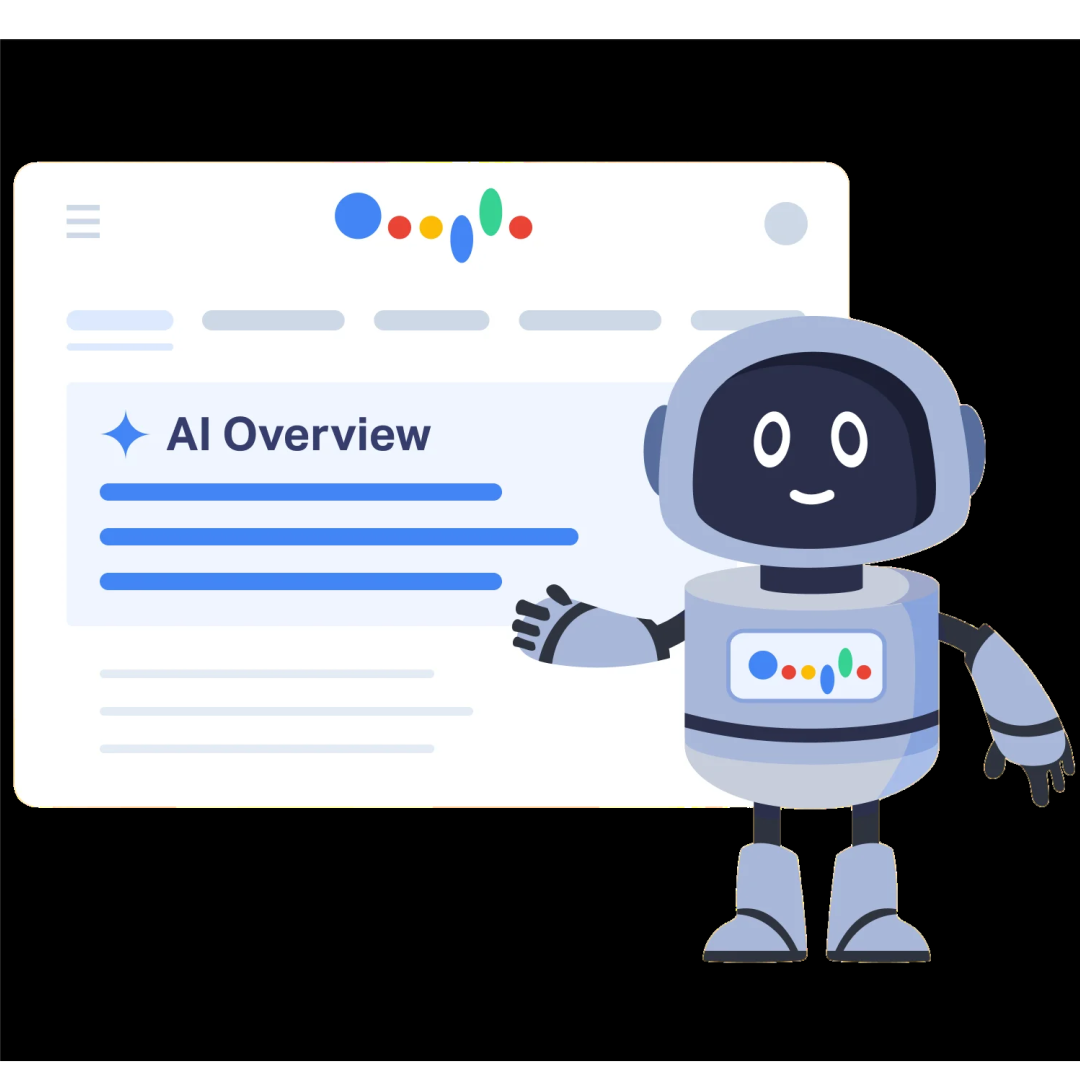
What is Answer Engine Optimization?
Answer Engine Optimization (AEO) is the practice of optimizing your content, structured data, and website to be recognized and cited as an authoritative source by AI-powered search systems. These systems include ChatGPT, Perplexity, Google AI Overviews, Claude, Grok, Gemini, Bing Copilot, and voice assistants.
Instead of fighting for a ranking position on a results page, AEO focuses on making your information easily discoverable, verifiable, and citable by AI models. When a user asks an AI system a question in your industry, your business appears as the source, driving visibility, authority, and trust.
Answer Engine Optimization Services
Schema Markup and Structured Data
Implementation of Product, Organization, FAQ, HowTo, Review, and LocalBusiness schemas that AI systems can understand and cite.
AI-Ready Content Strategy
Content optimized for both human readers and AI crawlers. Entity optimization, topical authority, and direct-answer formatting.
Product Catalog & Feed Optimization
Clean, structured product data that performs across Google Merchant Center, shopping feeds, and AI systems.
Rich Snippet and Featured Snippet Targeting
Optimization for knowledge panels, product cards, FAQ results, and other enhanced search result formats.
Why AEO Matters Now
Search behavior is shifting. Users now get answers from AI instead of clicking blue links
Early AEO investment gives you first-mover advantage as AI search grows
AEO and SEO overlap. Better schema markup improves both AI and traditional search visibility
Being cited as a source by AI drives sustained visibility and authority
Answer Engine Optimization Questions
Answer Engine Optimization (AEO) is the practice of optimizing your content, structured data, and website to be cited as a source by AI-powered search systems like ChatGPT, Perplexity, Google AI Overviews, Claude, Grok, and voice assistants. AEO focuses on making your information easily discoverable, verifiable, and citable by AI models. Unlike traditional SEO which optimizes for ranking in search result pages, AEO optimizes for being recognized and referenced as an authoritative source by generative AI systems.
Traditional SEO optimizes for appearing in search result pages (the goal is a ranking position). AEO optimizes for being cited as a source within AI-generated answers. Both require authority, quality content, and technical excellence, but AEO places heavier emphasis on schema markup, structured data, conversational content, direct answers to questions, and entity optimization. SEO answers the question 'How do I rank?' while AEO answers 'How do I become a source AI systems cite?'
To be cited in ChatGPT answers: (1) Implement comprehensive schema markup (Product, Organization, FAQ, and relevant schemas); (2) Create content that directly answers common questions in your industry; (3) Build topical authority by publishing depth and consistency; (4) Ensure your website is crawlable and technically excellent; (5) Maintain accurate, up-to-date information across your site and citations; (6) Build backlinks from authoritative sources to increase trustworthiness. ChatGPT trains on public web data, so authority and accessibility are key.
Google AI Overviews are AI-generated summaries that appear at the top of Google search results, synthesizing information from multiple sources. To optimize: (1) Target featured snippet positions (AI Overviews often pull from them); (2) Use clear, direct language with structured headers; (3) Implement FAQ schema for direct Q&A content; (4) Build backlinks to establish authority; (5) Ensure your site loads quickly; (6) Use natural keywords without stuffing; (7) Create comprehensive guides that cover topics thoroughly. Being cited in AI Overviews drives visibility even if your individual ranking drops.
For e-commerce, prioritize: (1) Product schema (includes name, price, availability, image, description, reviews, rating); (2) Organization schema (entity information, location, contact, social profiles); (3) Review & AggregateRating schema (customer feedback signals trustworthiness); (4) FAQ schema (answers to common product questions); (5) LocalBusiness schema if you have physical locations. Product schema is foundational for e-commerce because AI systems need structured, verifiable product data. Proper implementation increases chances of appearing in AI shopping responses.
Structured data (schema markup) helps AI systems understand what your content is about, who is responsible for it, and how to verify it. Instead of trying to parse unstructured text, AI can read Product schema and immediately know the price, availability, and ratings without interpretation. Structured data signals authority: 'this is an Organization with a verified address and phone number.' It improves accuracy in AI responses because the system can cite specific, verified information rather than inferring meaning. Think of it as 'machine-readable proof' of your claims.
Entity optimization involves making your business, products, and content clearly recognizable to AI systems as distinct, important entities. This means: (1) Maintaining consistent name, address, phone across the web; (2) Clearly defining what you do and who you serve; (3) Building topical authority around specific entities; (4) Using schema markup to explicitly define entity relationships; (5) Creating content that establishes your expertise in specific areas. AI systems use entity recognition to understand context and trustworthiness. Strong entity optimization ensures your business is recognized as an authority on your specific topics.
For Shopify AEO: (1) Audit and implement comprehensive schema (Product, Organization, LocalBusiness, FAQ); (2) Optimize product titles, descriptions, and images with keyword phrases and direct answers; (3) Implement rich snippets for reviews, ratings, and availability; (4) Ensure fast loading times and mobile optimization; (5) Clean up navigation and make product categories logical; (6) Create FAQ pages addressing common product questions; (7) Use Shopify SEO apps for structured data if native implementation isn't complete; (8) Build authority through customer reviews and digital PR. Most Shopify stores need schema enhancements beyond what the platform provides by default.
Absolutely. AEO is especially valuable for small Canadian businesses because: (1) Competition is lower than in large US markets; (2) AI systems actively cite smaller, specialized businesses when they have strong structured data; (3) Investment required is moderate (mostly strategy and schema implementation, not expensive paid ads); (4) Early movers gain advantage as AI search grows; (5) AEO complements SEO rather than replacing it; (6) Small, focused businesses with clear specialization rank better in AI's entity recognition. If you're a Canadian business with distinct expertise, AEO helps you get noticed by AI systems nationwide and globally.
GEO (Generative Engine Optimization) and AEO are often used interchangeably. Both refer to optimizing for AI-powered search. 'Generative' emphasizes that the search result is AI-generated (not a ranking list), while 'Answer Engine' emphasizes the Q&A format. The practical difference is minimal. Some people use GEO to specifically refer to optimization for pure generative AI (ChatGPT, Perplexity, Claude) and AEO to include hybrid systems like Google AI Overviews. Either way, the optimization strategy is the same: structured data, authoritative content, and entity clarity.
Interested in traditional SEO as well?
Ready for AI Search?
Get a free AI-readiness audit. We’ll assess your structured data, content optimization, and catalog readiness, then show you exactly what to implement first to get cited by AI systems.
Get Your AI-Readiness Audit30 minutes. No pitch. Real insights.